
Necrotic enteritis
Necrotic enteritis
Necrotic enteritis is one of the world’s most common and financially crippling poultry diseases, affecting approximately 40% of commercial broiler flocks. Clinical outbreaks can cause mortality rates of up to 50% and are estimated to cost the global broiler industry over US$5-6 billion annually. However, it is the subclinical form that often goes undetected and therefore not treated.
Necrotic enteritis is one of the world’s most common and financially crippling poultry diseases, affecting approximately 40% of commercial broiler flocks. Clinical outbreaks can cause mortality rates of up to 50% and are estimated to cost the global broiler industry over US$5-6 billion annually. However, it is the subclinical form that often goes undetected and therefore not treated.
Details
Necrotic enteritis is one of the world’s most common and financially crippling poultry diseases affecting approximately 40% of commercial broiler flocks. Clinical outbreaks can cause mortality rates of up to 50% and has been estimated to cost the global broiler industry upwards of US$5-6 billion annually. However, it is the sub-clinical form that often goes undetected and thus, untreated.
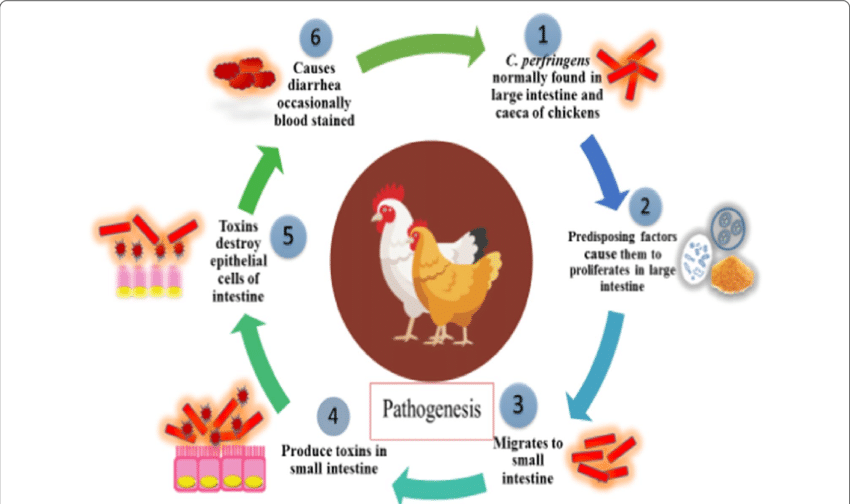
It is caused by an overgrowth of Clostridium perfringens type A and, to a lesser extent, type C in the small intestine. The toxins produced by C. perfringens also damage the intestinal wall.
Necrotic enteritis is commonly seen in 2- to 5-week old broiler chickens raised on litter and in 7-to 12-week-old turkeys. The disease will remain in the flock for 5 to 10 days, causing 2% to 50% mortality (Merck Veterinary Manual, 1998).
Necrotic enteritis is the cause of USD 6 billion losses every year in global poultry production, corresponding to USD 0.0625 per bird (Wade and Keyburn, 2015). This controllable disease is on the rise. One reason is the voluntary or legally required reduction of antibiotics in animal production due to the increasing occurrence of antimicrobial resistance but also consumer demand. Another reason is the administration of live Coccidiosis vaccines and partial reduction of ionophores, which also show efficacy against Gram-positive bacteria (Williams, 2005).
Necrotic enteritis and coccidiosis are the most significant health problem in broilers (Hofacre et al., 2018).
To control necrotic enteritis you have to deal with the pathogen and also predisposing factors
Predisposing factors
-lesion in intestine(coccidiosis – virus infection-myctoxins)
-increase intestinal viscosity
-immunosuppression
-imbalacing microbiota